
Youth Soccer Positions Explained for New Coaches
Learn the jobs behind youth soccer positions, how roles change in 4v4, 7v7, and 9v9, and what to fix when players lose the team shape.
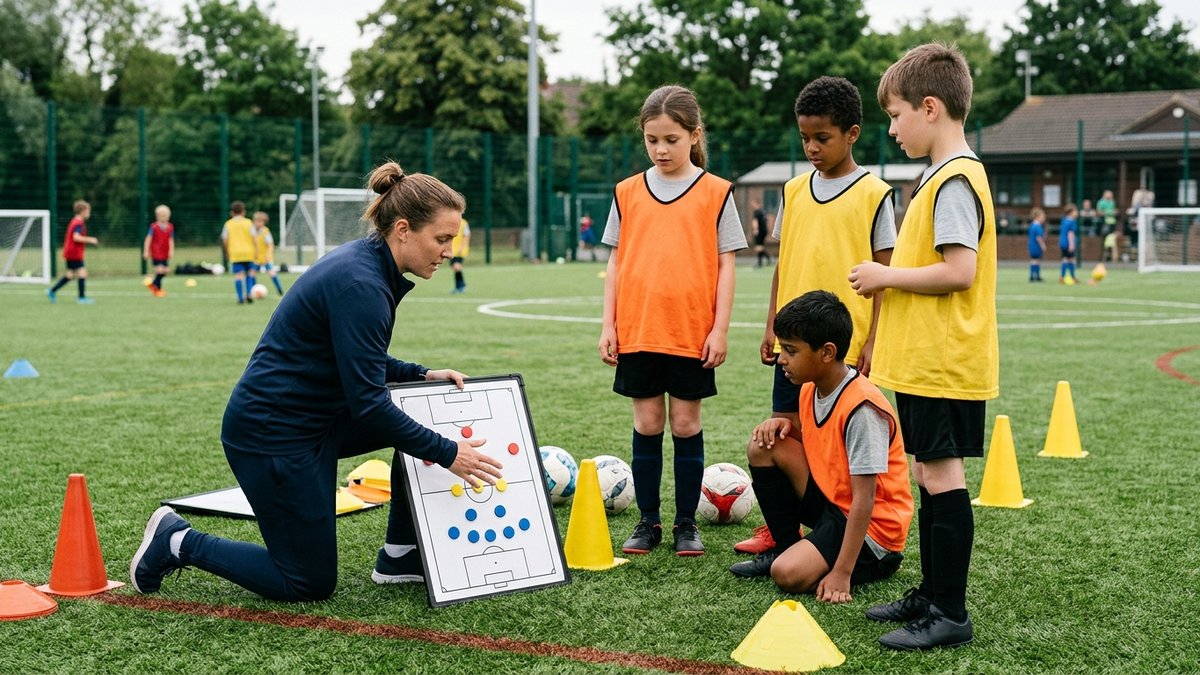
Ten players arrive for a 7v7 match. One is late, two both want to play forward, and your fullback follows the ball all the way across the field during warmups. The position names are easy. Giving each player a job that survives the first messy possession is the real coaching task.
New coaches often solve this by adding more instructions. The defender hears where to stand, the midfielder hears where to run, and the forward hears when to press. By kickoff, nobody can remember which detail matters when the ball moves.
Start with one decision per role. A position should tell a player what to notice and what action comes next. The formation gives those decisions enough spacing to work together.
What does each youth soccer position do?
Each position gives a player a different picture of the same possession. A useful explanation names where the danger or opportunity is, then gives the player one action.
Goalkeeper: Protect the goal and help the team start again. When the goalkeeper has the ball, the first decision is whether a short pass is safely available. When the other team attacks, the goalkeeper adjusts their distance from goal as the ball moves.
Defender: Stay connected to the goal side of the play and give the team a safe way out. A defender does not need to stand on one patch of grass. The player needs to recognize when to step toward the ball, when to cover a teammate, and when to recover toward goal.
Midfielder: Connect one part of the team to another. Before receiving, a midfielder looks for pressure and the next passing option. If the player can turn, the team may move forward. If pressure blocks the turn, the midfielder protects the ball or returns it to a teammate.
Forward: Give the attack depth and react when possession changes. A forward can move away from the ball to create a passing lane, check toward it to combine, or pressure the opponent who receives the first pass. Scoring matters, but waiting beside the goal is not the whole role.
Those jobs are deliberately short. A seven year old does not need the full tactical description of a center back or winger during a match. The player needs the next useful picture.
How do positions change from 4v4 to 7v7 and 9v9?
Positions become more specialized as the team adds players and lines. The same basic jobs remain, but players share them differently.
In 4v4, teach front, back, and wide support before introducing a long list of names. Imagine the ball with a player near the right touchline. One teammate offers a pass behind the ball, while another creates space ahead or across the field. If all three teammates run toward the ball, the problem is spacing rather than a missing position label.
In 7v7, a 2-3-1 gives new coaches two defenders, three midfielders, and one forward in front of the goalkeeper. The wide midfielders can give the team width, while the central midfielder connects the back pair to the forward. A 3-2-1 changes the defensive picture by adding a central defender and asking two midfielders to cover more ground.
In 9v9, three clear lines help players read relationships. A 3-3-2 can give the attack two forward options. A 3-4-1 can create more midfield connections. The better choice depends on the players available and the decisions you want them to practice, not which formation looks more advanced.
Before the match, place the chosen shape in your lineups and formations plan. Then give each line one job. The back line might protect the center first. The midfield might make one option ahead of the ball and one behind it. The forward line might keep one player high when the other checks toward the ball.
How should a new coach assign players to positions?
Assign a player to a role based on the decisions the player can currently see, then give the player another role to learn. Speed and size can help, but they should not decide the position by themselves.
U.S. Soccer’s Talent ID process uses reports from multiple sources, extended observation, and longitudinal monitoring. That is a national pathway, not a local rule for moving a U12 player. It gives a coach a useful standard: do not change a position because of one mistake or one short shift.
Use the Role Check during practices and matches:
- Name one job for the position.
- Watch five possessions without adding another instruction.
- Decide whether the player recognizes the picture, even if the technique fails.
- Keep the role, simplify it, or test the decision in a smaller game.
For a U10 player who wants to play central midfield, watch whether the player checks before receiving and sees the forward option. If the issue appears in one match or one role, keep the role and collect another observation. If the same decision breaks in training and matches, change the practice constraint before moving the player. If the player makes better decisions in another role across contexts, test that role for defined practice and match blocks before making a permanent change.
At the next practice, track five role-relevant decisions for one player in a small-sided game. Record the pressure, the choice, and the result. This gives you evidence for the next role decision instead of relying on one match.
What should you fix when players lose their shape?
Fix the smallest cause you can see. One player leaving a role calls for an individual cue. Several players breaking the same line calls for a formation or activity reset.
Picture a 7v7 team in a 2-3-1. The right fullback chases the ball to the left touchline. The right midfielder follows, and the central midfielder drops into the space both players left. When possession changes, the opponent has an open route down the right side.
If only the fullback crosses the field, give that player one cue: protect the goal side of your half before chasing. Watch the next possession. Do not stop the whole team for a long explanation.
If the fullback and wide midfielder repeatedly chase together, reset their relationship. Use a smaller directional game with a wide channel. Ask the midfielder to press the ball while the defender protects the space behind. Switch those jobs once the pair can keep their distance.
If the pair holds its shape but the team still cannot move forward, inspect the next connection. The central midfielder may be hiding behind an opponent, or the forward may be waiting on the same line as the defender. Change that support angle instead of moving everyone into new positions.
Score and time can also change the job. Late in a close match, a defender may hold a safer starting position. During a development-focused stretch, the same player may step into midfield after passing to experience a new picture. Tell the player which condition controls the choice.
How do you rotate positions without confusing the team?
Rotate one relationship at a time and give the new role enough repetitions to reveal a pattern. Moving every player after a few minutes creates activity, but it rarely gives the coach or player useful evidence.
Keep a small part of the shape familiar. In 7v7, you might keep one defender and the central midfielder in their usual roles while a wide player tries fullback. That player can learn when to support, when to delay an attacker, and where to recover without the entire team changing around them.
If the player makes the intended decision but struggles with the pass or tackle, leave the player in the role long enough to try again. If the player cannot identify the job after a clear cue, return to a familiar role and rehearse the new decision at practice. If the whole line becomes disconnected, reduce the number of changes in the next rotation.
The separate guide to rotating soccer positions without confusion explains how to plan those role blocks across several matches. Track position exposure alongside minutes so one child does not receive every learning role while another stays in the same spot. The playing time tracker guide can keep those records together.
Youth soccer positions FAQ
What is the easiest soccer position for a beginner?
No position is automatically easiest, but a wide role can give a beginner a clearer field boundary and fewer directions to check. Pick a role with one visible job, then adjust after watching the player in several possessions.
Where should the fastest player play?
Speed can help at forward, winger, or outside back. Watch what the player notices at speed. A fast player who attacks open space may help higher up the field, while one who recovers quickly and reads danger may learn more as a defender.
Should young players stay in one position?
Young players benefit from seeing the game from more than one role. Keep one role familiar while introducing another through practice and planned match blocks. Random movement every few minutes makes it harder to tell what the player has learned.
How do you explain positions to children?
Give each child one job connected to the ball, goal, or nearest teammate. Replace a lecture about zones with a cue such as protect the middle, show beside the ball, or stay high enough to stretch the field.
What if every player chases the ball?
Treat that as a team spacing problem when several players do it. Freeze one clear picture, move players back to connected distances, then restart in a smaller game where width or depth creates an obvious advantage.
At the next session, give each line one job and watch the first five possessions. Write down whether one player breaks the role or several players lose the same relationship. That note tells you whether the next intervention belongs with a child, a pair, or the activity itself.
Sources
NEXT STEP FOR LINEUPS
Build the shape before the first whistle.
Choose the formation, assign player roles, and keep the saved lineup close when match setup starts.