
Why Are Clubs Still Teaching Basics at U12?
When U12 players still need foundational ball skills, the answer is not blame. It is a clearer plan for technique, free play, and game application.
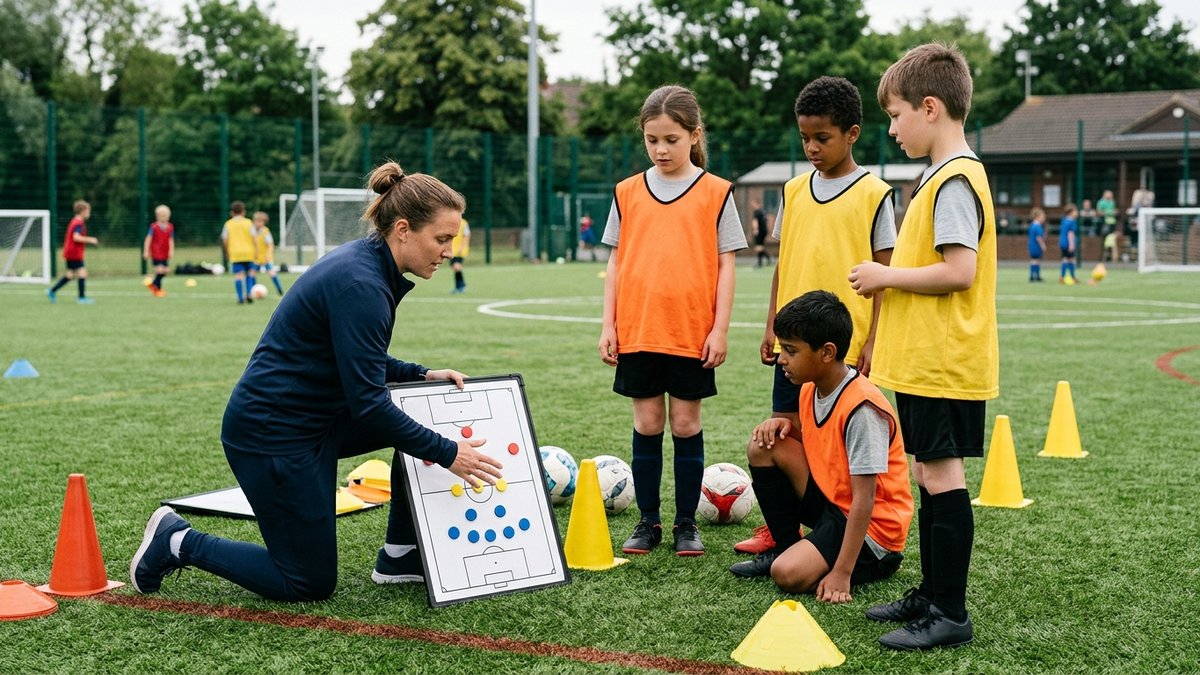
An U12 player should not be embarrassed for needing help with a first touch, a pass, or striking the ball. The player is twelve. The question is why the system waited so long to make those actions part of the work.
Clubs see this every season. A group arrives at 9v9 with different backgrounds, different amounts of ball contact, and different coaching. Some players can receive under pressure and play with either foot. Others are still trying to get the ball under control before the next defender arrives. The gap is real. Pretending it is not there does not help anyone.
Why do U12 players arrive with such different skill levels?
U12 players arrive with different skill levels because childhood soccer experiences are not equal. One child may have played every day at home, joined pickup games, had a prepared rec coach, and trained in a small-sided environment. Another may have had one team practice a week, a coach who was learning alongside the group, and little chance to touch the ball outside a crowded match.
Neither player chose the pathway. The club coach inherits it.
That is why the right response is not to complain that players should already know the basics. The response is to diagnose what the group needs. Can players receive with an open body? Can they pass with enough weight? Can they dribble away from pressure? Can they use the weaker foot when the game makes it necessary? Can they see a teammate before the ball arrives?
Those questions are practical. The answers should shape training.
Are technique and tactics separate at this age?
No. Technique and tactics meet every time a player tries to carry out an idea. A player can recognize the free teammate and still fail to find that teammate if the pass is slow, misplaced, or played from a closed body shape. A player can understand the value of width and still struggle to control the ball near the touchline.
That is why technical work should have a reason. FIFA’s U12 example from Clearwater Chargers describes a club that connects skill acquisition, small-sided games, and progressive training. Its coaches describe “technique on demand” as the ability to play the ball how and when a player chooses, with either foot and under pressure. The phrase is useful because it moves beyond a clean drill. The skill has to show up when the player needs it.
Spain’s youth identity offers a related lesson. Its emphasis on receiving, supporting, passing, and recovering the ball asks players to solve repeated game moments with technical confidence. The useful takeaway is not copying Spanish language or a formation. It is accepting that an idea of play has no value if players have not been given the tools to carry it out.
Should a club stop playing games to fix technique?
No. Players need games to understand why a technique matters. The answer is to make games and focused work support each other.
Use a small game to show the problem. If players are losing the ball on the first touch, set up a 3v3 or 4v4 activity where they must receive from different angles and pressure arrives quickly. Then use a focused activity that lets each player repeat receiving and turning. Finish with another game where the first touch creates a scoring chance or a passing lane.
That sequence gives a player more than instruction. It gives a memory of when the skill helped. A coach can say, “Your first touch opened the field,” and the player knows what that felt like.
U.S. Soccer’s small-sided standards were designed to increase meaningful involvement, touches, and decisions for young players. Smaller games do not remove technical work. They give it more chances to matter.
What does free play add that training cannot?
Free play gives children repetitions they choose themselves. They try the move again because they want to beat a friend, not because an adult counted the repetition. They improvise in smaller spaces. They learn what the ball does when the touch is too big, too soft, or taken on the wrong foot.
That does not mean every child has a street soccer culture outside the home. Many do not have a safe space, a nearby group, or time without adult scheduling. Coaches and clubs should not romanticize what families cannot provide.
They can make more room for it. End a session with player-led games. Keep a few balls available before training begins. Encourage a player to bring a ball to a sibling’s game. Give the group a simple challenge that does not require a paid private lesson. The point is more ordinary contact with the ball, not another expensive program.
FIFA’s grassroots material encourages coaches to let young players experiment and solve situations independently in free play. That is a useful reminder for adults who think every minute has to be controlled to count as development.
How should a coach build a U12 technical plan?
Build the plan around the actions that keep showing up in games. Watch a match and write down two patterns. Perhaps players cannot receive away from pressure. Perhaps passes into the striker are too soft. Perhaps players can beat one defender but cannot make the next decision.
Choose one main theme for the week. Use an activity with enough repetition, then use a small-sided game that makes the action necessary. Keep the coaching point short. Ask the player what changed after a good action. Repeat the theme over several weeks instead of declaring it fixed after one practice.
Use the See, Separate, Recheck test. See the same action in a 4v4 opening game, separate an individual technical problem from a group picture, then recheck it in the closing game. Picture a U12 right winger receiving beside the touchline while an inside defender closes. If one player takes three first touches into that pressure, then give that player a receiving angle and another repetition. If several players receive square and lose the ball on the same side, then change the service angle or widen the channel before correcting each player.
Use a session plan to keep the theme connected from warmup to game. A coach who arrives with a clear problem is less likely to fall back into an hour of unplanned match play.
The plan should also include player roles. Give a player who needs receiving work chances to receive in meaningful areas. Do not hide that player in the least demanding spot every week. The player may make mistakes. That is where the learning is.
What should parents hear from a club?
Parents should hear that basic technique is serious work, not evidence that their child has failed. A club should be able to explain what the group is learning and how practice connects to games. It should not promise that every U12 player will suddenly look polished after a month.
The more honest message is better: “We are working on receiving under pressure. You will see turnovers while players take more responsibility for the ball. We will watch for open body shape, a better first touch, and the next pass.” That gives families something real to notice.
Parents can support without becoming another coach. Give the child a ball. Ask what the group worked on. Watch a match without treating every lost ball as a crisis. Read how a playing identity gets built over time for the longer view, and see what Pitch Planner believes about youth development for the standards behind it.
At the next session, count the first five receptions beside the touchline in the opening 4v4 game. Mark which players open away from pressure before the ball arrives. Repeat the count in the closing game, then choose one individual cue or one change to the activity from what you can see.
FAQ
Is U12 too late to learn technical skills?
No. U12 players can make major technical progress. Earlier ball contact gives more time to build on the skills, but coaches should teach what the current group needs.
Should U12 players train both feet?
Yes. Players should get regular chances to use both feet in activities and games. The goal is useful confidence, not a perfect weak foot before they are allowed to play.
How much technical work should a U12 session include?
Include enough focused repetition to improve the current theme, then give players a game where they can use it. The exact time depends on the group, the session length, and the problem being taught.
What is the biggest mistake a club can make with U12 technique?
Assuming players already have the base, then spending every session in match play. The group needs a plan that acknowledges the gap and gives players repeated, game-connected chances to close it.
NEXT STEP FOR YOUR TEAM
Put the next coaching decision in one place.
See how Pitch Planner connects team setup, practice planning, lineups, substitutions, and match records for youth soccer coaches.