
Why U.S. Youth Soccer Is Still Teaching Basics at U12
Many U.S. coaches inherit U12 players who still need basic technical work. The answer is more purposeful repetition, not less ambition.
Published · Updated
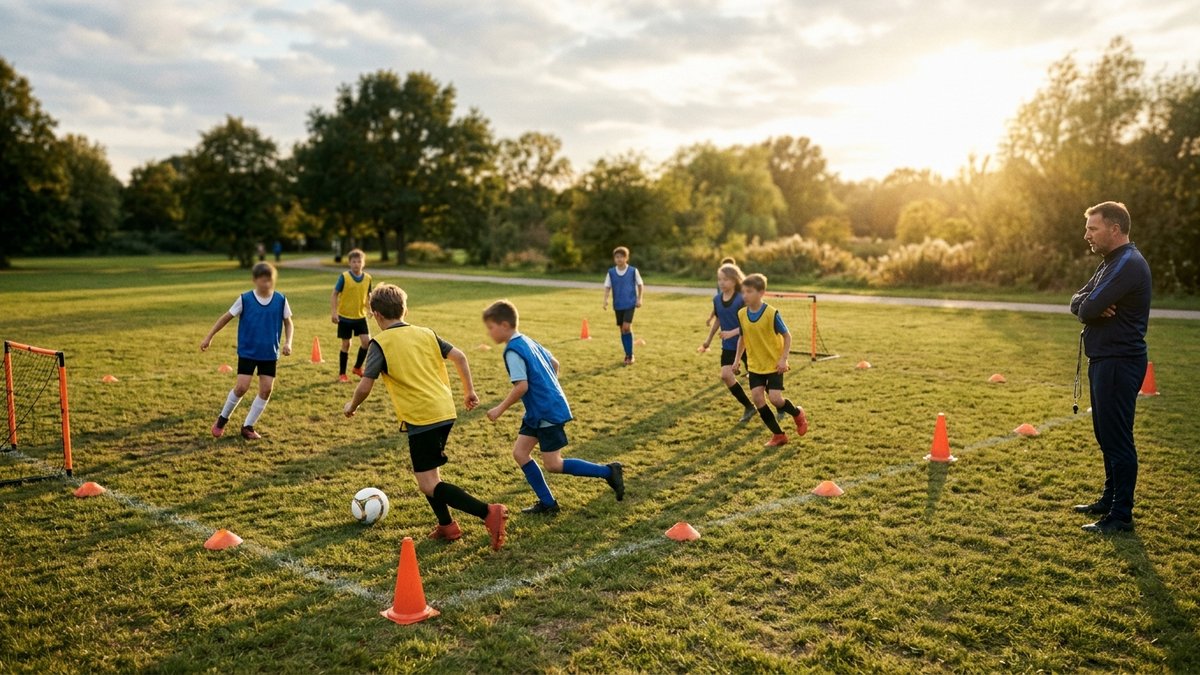
An U12 player should not be finished learning how to pass, control the ball, or shoot. But a coach should not be meeting those skills for the first time at U12 either.
That is one of the biggest differences American coaches feel when they watch countries with deeper soccer cultures. In some places, players arrive at organized training with years of informal play and early ball work already behind them. In too many U.S. environments, the team session has to carry the full technical load.
Why are basic skills still missing at U12?
There is no single answer. Some children began soccer later. Some teams have limited training time. Some coaches have large groups and few assistants. Some sessions spend too long in lines. And some adults rush past technique because advanced tactics look more impressive from the sideline.
The last one is a trap. You cannot ask a player to play through pressure if they cannot receive a pass cleanly. You also cannot solve that problem by spending every session on an unopposed passing pattern. Players need the touch and the decision together.
What should technical work look like at U12?
It should have a football problem attached to it. Use a passing activity where the receiver has to scan for a color or number before the ball arrives. Use a finishing game where the shot follows a change of direction or a decision about the goalkeeper. Use a 4v4 game that rewards the first player who takes a clean touch away from pressure.
Spain’s youth national-team approach puts technical quality and game understanding together. David Gordo describes the importance of controlling and passing the ball, then explains that players must also read the game and provide the best option for a teammate.1
That is the standard to borrow. Do the technical repetition. Then give it a reason to exist.
Use the Touch, Choice, Pressure check when you plan the activity. If the player cannot perform the touch, reduce the pressure and give them another clean repetition. If the touch works but the player chooses the wrong option, keep the pressure and change the question. If the player makes the choice but the group cannot support it, fix the spacing before blaming the technique.
For example, in a 4v4 game with end zones, watch the first three receiving actions. If a player takes the ball across their body and escapes pressure, ask for the same action on the next turn. If the player takes a clean touch but has no forward option, move a teammate into a support angle. The coach is testing a decision, not just counting touches.
What should coaches stop doing?
Stop treating a weak first touch as a personal flaw. It is information. The session needs more well-designed repetitions, and the player may need more time with the ball outside formal practice.
Stop turning every player into a specialist before they can solve basic problems. A player who only plays center back because they are tall may miss hundreds of attacking touches. A player who is quick may survive by running past opponents without learning how to combine. Youth soccer is where those gaps can still be addressed.
And stop confusing intensity with learning. A loud, exhausting session can still leave players with very few quality touches.
What can parents do without becoming another coach?
Help make the ball part of normal life. A child can juggle, pass against a wall where it is safe, play pickup, or work on simple moves in a driveway or yard. Do not turn every touch into a test. The goal is more comfort with the ball.
Parents can also ask better questions after a match. Instead of asking only whether the team won, ask what the player tried, what felt difficult, and what they want to practice next time. That kind of patience is part of development too.
How should a coach plan the season?
Choose a technical theme for each block, then return to it in different game contexts. A first-touch block can include receiving away from pressure, receiving forward, and taking a touch to set up the next pass. Track the theme in your practice planning notes and compare it with what happens in matches. Use the match-day tracker to note whether the behavior holds when the score and substitutions change.
The goal is not to finish a skill in one week. The goal is to give players enough repetitions that the action becomes available when the game gets fast.
What does progress look like when technique is the priority?
It looks quieter than a tournament medal. A player who used to need three touches may need two. A pass that used to bounce away may arrive at the next player’s feet. A player may start checking a shoulder before receiving instead of staring at the ball.
Coaches should point out those changes. Players need to know what improvement looks like when it is not a goal. Parents need to see that a technical target is not an excuse for low standards. It is a standard that can be observed over time.
Use the same target in more than one setting. Work on receiving in a tight 3v3 game, then look for it in a larger scrimmage. If it disappears in the larger game, that does not mean the session failed. It tells the coach where pressure is still winning. That is useful information for the next week.
Before the next session, write down one touch you want to see, one choice that should follow it, and the pressure you will add if the group solves it. If the behavior never appears, simplify the task. If it appears in practice but not in the match, review the player-minute and role record before changing the season goal.
How can a coach keep technique from becoming boring?
Use competition without making every touch a judgment. Set small challenges. Can a pair keep the ball for five passes under pressure? Can a player receive and escape through a gate? Can the group finish after a combination rather than a hopeful shot?
Players enjoy getting better when they can feel the reason for the work. The coach does not need to entertain them every minute. The activity needs a purpose that makes the repetition worth doing.
What happens if the team skips this work?
The gap usually shows up when the game speeds up. Players avoid the ball, rush a pass, or solve every difficult moment with a clearance. The team may still compete, but the players have fewer tools when the opponent is better organized.
That is why technical work is not a beginner phase that ends. It is part of every season, with the problem getting harder as players grow.
The player who becomes comfortable with the ball has more ways to enjoy the game. They can try something instead of hiding from the next difficult touch. That confidence matters at every level.
It also lets a coach ask for more from the player later, because the player has a technical base to fall back on when the game becomes faster and more physical.
FAQ
Is it too late to improve technique at U12?
No. U12 players can make major technical progress. They need frequent, purposeful touches and activities that connect technique to a game decision.
Should U12 training be all small-sided games?
No. Small-sided games are valuable, but use the format that fits the learning goal. Add larger spaces when players need to work on width, switching play, or team shape.
How long should a technical block last?
Keep revisiting it over several weeks and through the season. A single session rarely changes a lasting habit.
What should a parent practice with a player at home?
Keep it simple: ball mastery, passing, receiving, and playful repetition. Avoid turning every activity into pressure or judgment.
Sources
Footnotes
-
FIFA Training Centre: David Gordo on Spain’s playing style, March 4, 2025. ↩